
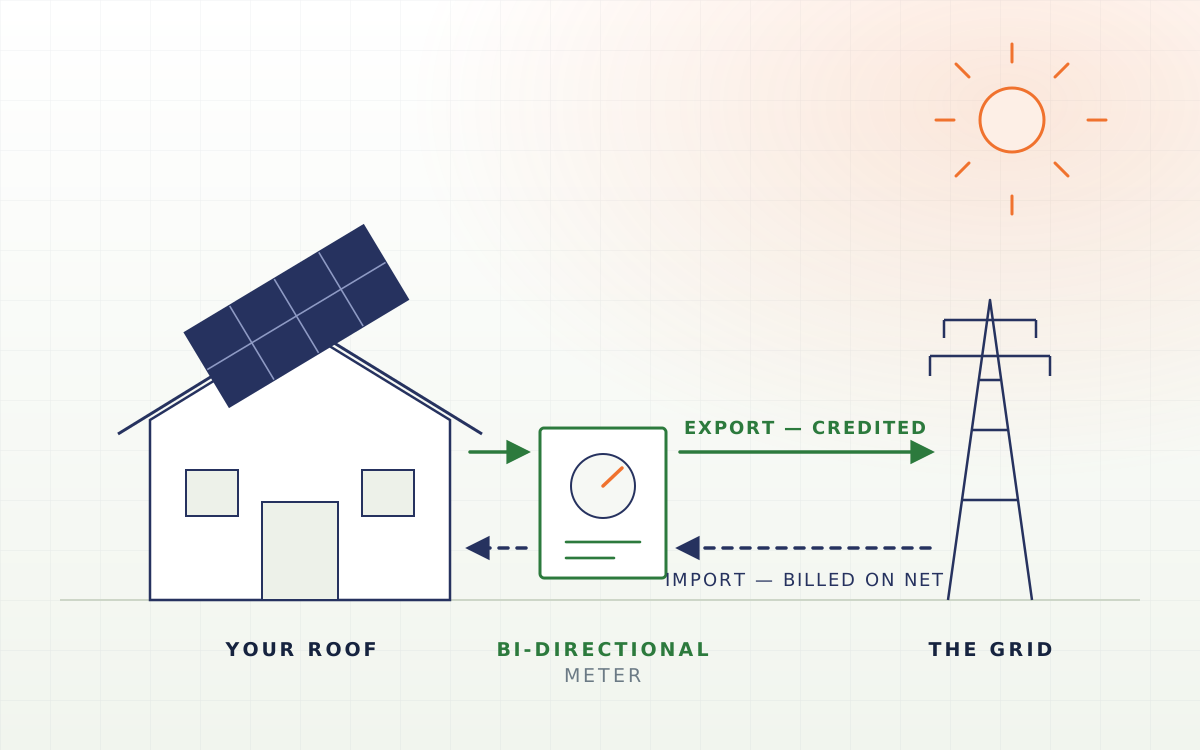
Most conversations about rooftop solar in Bangladesh stall at the same question: what happens to the electricity I don't use?
The answer is net metering, and the rules governing it are more permissive than most building owners assume — but also more procedural. This is what the guidelines actually permit, and where applications usually get stuck.
The 70% ceiling
Under Bangladesh's Net Metering Guidelines, a customer may install a rooftop system rated up to 70% of their sanctioned load. Not 70% of consumption, and not 70% of roof area — sanctioned load, the figure on your connection agreement.
If your sanctioned load is 15 kW, your ceiling is 10.5 kWp. This catches people out, because roof area and appetite frequently exceed what the connection permits. There are two ways forward when they do:
- Size the system to the ceiling and accept it.
- Apply to revise the sanctioned load upward first, then apply for net metering against the new figure.
The second route takes longer but is often correct for factories, where sanctioned load was set years ago against a smaller plant.
Which utilities participate
The guidelines apply nationally across the distribution utilities:
| Utility | Coverage |
|---|---|
| DPDC | Central and south Dhaka |
| DESCO | North Dhaka, Gulshan, Uttara, Tongi |
| BPDB | Various urban and industrial areas |
| BREB / REB | Rural distribution nationwide |
| WZPDCL | Western zone, Khulna region |
| NESCO | Northern zone, Rajshahi and Rangpur |
Procedure is broadly consistent but form templates, inspection scheduling and turnaround differ meaningfully between them. A submission that sails through DESCO can be returned by BREB for formatting.
How the credit actually works
A bi-directional meter records import and export separately. At the end of the billing period you are charged on the net.
If you export more than you import, the surplus does not become a cash payment. It carries forward as kWh credit against future periods. This single fact should drive your system sizing: a system built to fill the roof rather than to match consumption accumulates credit it may never convert into value.
The practical consequence is that a strong dry season (November to March, when irradiance is high and cloud cover is low) builds credit that offsets a weaker monsoon. Annual balance is the number that matters, not monthly.
Where applications get stuck
In our experience, delays are almost never technical. They are documentary. The submission needs:
- The utility's net-metering application form, completed against the exact name and account on the bill
- A single-line diagram showing the array, inverter, protection devices and the metering point
- Equipment test certificates for panels and inverter
- Certification by a licensed electrician
- Proof of ownership or a landlord's no-objection certificate
- The most recent electricity bill
The two that most often come back are the single-line diagram — which needs to show protection coordination, not just a block layout — and the landlord NOC for tenanted premises. Both are avoidable with preparation.
A realistic timeline
Four to ten weeks from filing to meter changeover is normal. Faster is possible with a complete first submission; slower usually means a document was returned.
The array itself can be installed while the application is in progress. Many of our clients commission in self-consumption mode and switch to net metering when the bi-directional meter arrives, so the system is earning from day one rather than waiting on paperwork.
Solar Masters prepares and files net-metering documentation as part of every grid-tied installation. If you want your sanctioned load and eligibility checked before you commit to anything, send us your last bill.